
What does Hebrews 10:26-31 mean about wilful sin after knowing the truth?
Question 6166.
The Hebrews 10 warning has probably cost more sleep among sincere believers than any other paragraph in the New Testament. “For if we go on sinning deliberately after receiving the knowledge of the truth, there no longer remains a sacrifice for sins.” Read that at two in the morning after a bad week and you will understand why people would write to me about it.
I want to walk through the passage properly, because the fear it produces usually comes from reading four verses in isolation rather than from reading the letter. When you put it back into its argument it turns out to be saying something rather different from what the anxious reader assumes.
Who the letter was written to
Hebrews was written to Jewish believers under pressure, almost certainly before the destruction of the temple in AD 70. The temple was still standing, the sacrifices were still being offered, and returning to the old system was a live and attractive option for people who were being ostracised, dispossessed and in some cases imprisoned for following Jesus.
The whole letter argues one case. Jesus is better. Better than angels, better than Moses, better than Aaron, better than the covenant, better than the sacrifices. Every warning in the letter is aimed at one specific danger, which is going back.
That context governs everything. The Hebrews 10 warning is not a general statement about believers who sin badly. It is aimed at a particular temptation in a particular crisis, and the sin in view has a name, which is apostasy.
Reading the passage in its paragraph
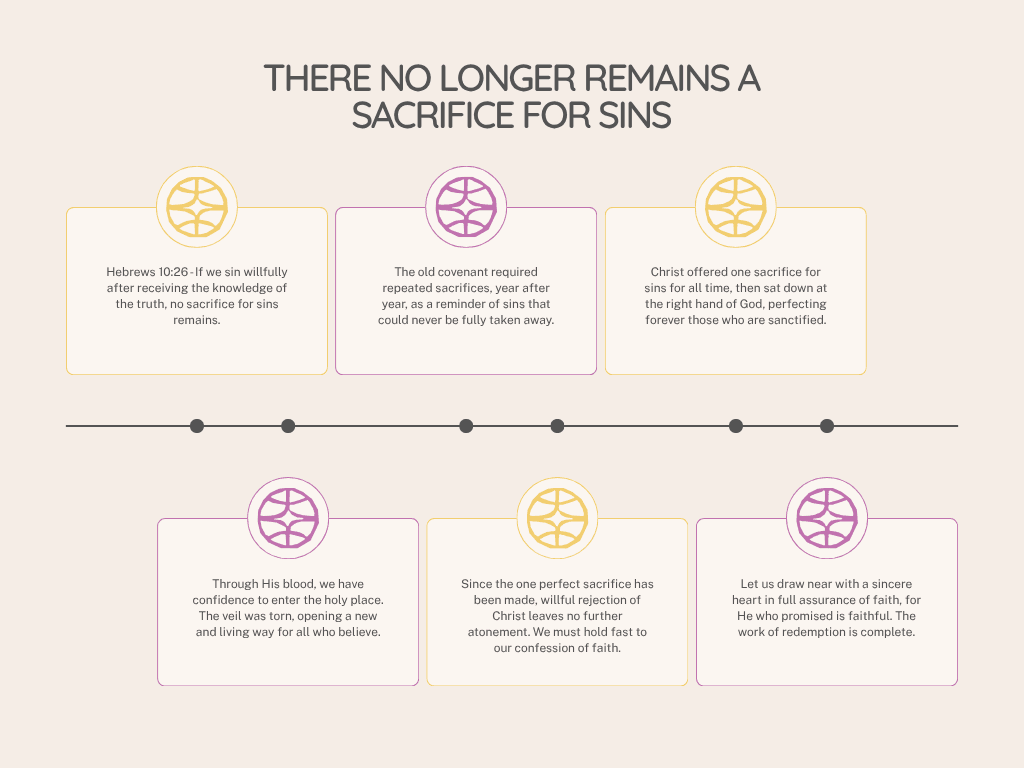
Look at what comes immediately before. The writer has just finished demonstrating that the sacrifice of Jesus is once for all and that by a single offering he has perfected for all time those who are being sanctified. He then urges his readers to draw near with a true heart in full assurance of faith, and to hold fast the confession of their hope, and not to neglect meeting together.
Then comes the warning, introduced by the word “For”. It is the reason why they should hold fast. And the logic is straightforward. If you walk away from the one sacrifice that works, there is nothing else on offer, because the animal sacrifices you are thinking of returning to never took away sins in the first place.
You can read the passage for yourself at Hebrews 10:19-31, and I would encourage you to read from verse 19 rather than starting at verse 26, since the paragraph break matters.
What sinning deliberately means here
The word translated deliberately is hekousios, meaning willingly or of one’s own accord. It stands in deliberate contrast to the Levitical category of sins committed unintentionally, for which the sacrificial system made provision. Under the law there was no sacrifice for the high handed sin of the man who acted defiantly and despised the word of the Lord.
Note also the tense. The construction is continuous, going on sinning, not committing a single deliberate act. Every believer sins deliberately in the ordinary sense, and often. If a single wilful sin were in view here, nobody would be left standing, including me. Especially me.
So the Hebrews 10 warning is not about a Christian who loses his temper knowingly, or looks at what he should not, or tells a lie and hates himself for it afterwards. It is about a settled, continuing, defiant course, and the next verses make the character of that course explicit.
The three descriptions in verse 29
The writer describes the person in view with unusual force. He has trampled underfoot the Son of God. He has profaned the blood of the covenant by which he was sanctified, treating it as a common thing. He has outraged the Spirit of grace.
So, pause here. The language is telling. Trampling is contempt expressed with the feet. Profaning the blood is looking at the cross and calling it worthless. Outraging the Spirit is insulting the one who bore witness to Jesus. This is not the vocabulary of a struggling saint. It is the vocabulary of somebody who has examined the claims, understood them and publicly repudiated them.
The phrase by which he was sanctified causes some difficulty, and there are two reasonable readings. Either the sanctification refers to the covenant community setting, as it does in the Old Testament of Israel as a whole, or the pronoun refers to Jesus himself who was set apart by that blood. Either way, external association with the people of God is not the same as regeneration.
Does the Hebrews 10 warning threaten eternal security?
Here is where I want to be careful, because I am neither Calvinist nor Arminian and I do not want to solve this with a system. I want to solve it with the letter itself.
The same writer has already said that Jesus is able to save to the uttermost those who draw near to God through him, since he always lives to make intercession for them. He has said that by one offering he has perfected for all time those who are being sanctified. A man who wrote those sentences is not, forty verses later, teaching that a genuinely redeemed person can be lost.
What he is doing is describing a real danger for real people in a mixed congregation. Some of his readers were believers who needed to hold fast. Some were associated with the community, impressed by it, enlightened about it, and had not actually come to rest on Jesus at all. The Hebrews 10 warning addresses both groups at once, and it does what warnings are for. I take the same approach to the parallel passage in what Hebrews 6 teaches about falling away.
Warnings are a means, not a threat
People sometimes object that a warning is meaningless if the outcome is secure. This is hardly persuasive. A father who shouts at his child running towards a road is not admitting that the child will be run over. The shout is part of how the child is kept safe.
Paul on the ship to Rome is the clearest biblical case. God had told him plainly that every soul aboard would be spared. Then, when the sailors tried to escape in the boat, Paul said that unless these men stay in the ship you cannot be saved. The promise was certain and the means were still necessary.
The Hebrews 10 warning functions in exactly that way. God uses it to keep his people from drifting, and he uses it to strip false assurance from those who have never truly believed. Both effects are merciful. Always mercy before judgement with God.
Judgement, fire and the fearful thing
The passage speaks of a fearful expectation of judgement and a fury of fire that will consume the adversaries, and then quotes Deuteronomy on vengeance belonging to God. It ends with the sentence that gives the passage its weight. It is a fearful thing to fall into the hands of the living God.
Some take the judgement here as the discipline of a believer rather than final condemnation, pointing to the quotation about the Lord judging his people. I understand the argument and I do not think it fits the language of adversaries and consuming fire. The imagery belongs to final judgement.
Notice, though, what the verse actually says about God. The terror is not that he is capricious. It is that he is living, and therefore real, and therefore not to be managed with religious performance. That is a warning to the nominal far more than to the troubled.
How the writer himself applies it
This is the part that almost everyone skips, and it settles the pastoral question. Immediately after the warning, the writer says this. But recall the former days when, after you were enlightened, you endured a hard struggle with sufferings. You had compassion on those in prison. You joyfully accepted the plundering of your property.
Then he adds, we are not of those who shrink back and are destroyed, but of those who have faith and preserve their souls. He explicitly places himself and his readers outside the category he has just described. Having sounded the alarm he immediately reassures them.
That is how the Hebrews 10 warning is meant to land. Sober, yes. Terrified, no. If the passage leaves you convinced you are the apostate it describes, you have almost certainly misread both the passage and yourself.
A word to the person who is frightened
The people described in this passage are not afraid. That is the single most useful observation I can give you. They have trampled, profaned and insulted, and they feel nothing about it whatsoever. A man who has come to despise the blood of Jesus does not lie awake worrying that he has despised the blood of Jesus.
Your fear is not evidence of apostasy. It is evidence of a conscience that the Holy Spirit is still using. Bring the actual sin, whatever it is, and find it forgiven, because one of my used and favourite Bible verses in all of Scripture is 1 John 1:9, which is written to believers and has no exception clause attached.
If assurance is the deeper issue, and it usually is, I have set out the biblical grounds for it in what is assurance of salvation and dealt with the broader question in can a true Christian fall away.
How the Hebrews 10 warning relates to the other four
This is not an isolated paragraph. The letter contains a series of warnings, usually counted as five, and they escalate. Do not drift. Do not harden your heart as Israel did in the wilderness. Do not remain immature and fall away. Do not go on sinning deliberately. Do not refuse him who is speaking. Read together they form a single sustained appeal.
Seeing that pattern helps, because the Hebrews 10 warning is often lifted out and treated as a freestanding threat. It is not. It is the fourth movement in an argument that began in chapter two with the gentle observation that we must pay closer attention lest we drift away. Drifting, not diving, is how the letter expects people to be lost.
Israel in the wilderness is the controlling illustration. Those people had seen the plagues, walked through the sea and eaten the manna, and they still did not enter the land because of unbelief. External privilege without faith saved nobody then, and the Hebrews 10 warning applies that lesson to a congregation with equally impressive credentials.
The Jewish background that makes it click
Everything in this section depends on the sacrificial system, and a reader who does not know Leviticus will miss the force of it. Under the law there were offerings for sins committed unintentionally, in error, through weakness or ignorance. There was no offering at all for the man who sinned with a high hand, defiantly, in open contempt of the covenant. He was cut off.
The writer is using that distinction on purpose. His readers knew it intimately. When he says there no longer remains a sacrifice for sins, his first century Jewish audience would immediately hear the echo of the high handed sin of Numbers 15, and the Hebrews 10 warning would land as a covenantal category rather than as a measure of how badly a person had behaved.
There is a second echo too. The passage cites the law of Moses, where a man died without mercy on the evidence of two or three witnesses, and argues from the lesser to the greater. If rejecting Moses brought that, what does rejecting the Son bring? The reasoning is entirely at home in a synagogue, and Numbers 15:30 is where the argument begins.
Israel and the Church remain distinct
One further observation, and it matters for how the Hebrews 10 warning is applied. The letter is written to Jewish believers whose national identity, family ties, livelihood and place of worship were all bound up with the old covenant system. Walking away from Jesus for them meant walking back into a functioning temple with priests and altars.
That situation no longer exists in the same form, and we should be careful not to flatten the historical particulars into a general principle about backsliding. God’s programme for Israel and his programme for the Church are distinct, and Hebrews sits precisely at the seam between them.
The abiding principle survives the change of circumstance. There is no second sacrifice, no alternative arrangement and no religious system that can substitute for the finished work of Jesus. Anybody in any century who turns from that has nowhere else to go, which is exactly what the Hebrews 10 warning says.
What this passage is not saying
Let me list the misreadings I meet most often, since clearing them away does a great deal of pastoral good. It is not saying that one deliberate sin forfeits forgiveness. It is not saying that a believer who falls into a long period of disobedience has run out of grace. It is not the unpardonable sin, which concerns attributing the work of the Spirit to Satan and belongs to a different discussion altogether.
Nor is it saying that forgiveness has a limit measured in offences. Jesus answered that question directly when Peter proposed seven times, and the answer was seventy times seven, which was not a new arithmetic but a refusal of arithmetic. A God who forgives like that has not written the Hebrews 10 warning to cap his own mercy.
What it is saying is that the only sacrifice there is has been offered once, and that turning from it deliberately and finally leaves a person with nothing. That is not a limit on grace. It is a statement about where grace is found, and Hebrews 10:14 has already told us how complete that one offering is.
Preaching the Hebrews 10 warning responsibly
Preachers do real damage with this text when they aim it at the wrong people. Delivered to a tender congregation as a general threat, it wounds the sensitive and leaves the hardened untouched, which is the exact reverse of its purpose. The Hebrews 10 warning was written to be heard by a mixed group, and the writer follows it immediately with encouragement for those who have endured.
So preach it as he did. Name the danger plainly, describe the apostate accurately, and then turn and reassure the believers in the room before you sit down. A sermon on the Hebrews 10 warning that ends at verse 31 has stopped eight verses too early and left the congregation holding the fire without the hope.
So, now what?
Read Hebrews 10 from verse 19 to verse 39 in one sitting, out loud if you can. The warning sits between an invitation to draw near with full assurance and a commendation of their past endurance, and the sandwich changes the flavour entirely.
Then do the thing the passage actually asks you to do, which is not to introspect but to hold fast and to keep meeting with the Lord’s people. The writer prescribes fellowship as the remedy for drift, which is a striking piece of pastoral wisdom.
If you have been trying to solve this alone in your own head at midnight, is it possible that the answer involves other people and a Sunday?
“But we are not of those who shrink back and are destroyed, but of those who have faith and preserve their souls.” (Hebrews 10:39, ESV)
For Further Study
Charles Ryrie handles the warning passages briefly but clearly in Basic Theology, and Lewis Sperry Chafer gives them extended treatment in his Systematic Theology, particularly in his discussion of the security of the believer. J. Dwight Pentecost’s expositional work on Hebrews is worth having for the way it keeps the Jewish setting in view, and John Walvoord is reliable on the relationship between the covenants which stands behind the whole letter. Millard Erickson’s Christian Theology surveys the alternative readings fairly if you want to see how others handle the same verses, and Arnold Fruchtenbaum is useful on the first century Jewish background to the pressure these believers were under.
Looking for another question to explore?
🎲 Try a Random Question